Free Maarten: The Ordeal of Maarten Blok
PLEASE NOTE THAT THIS IS PAGE CONTAINS ARCHIVED CONTENT OF THE ORIGINAL SITE.
This site was created to document the egregious arrest and subsequent trial and acquittal of Maarten Blok in 2004. The site was live for several years and then its domain expired. Recently I discovered that the domain was available, so I bought it with the goal of recreating as much of its original content as possible from archived pages. I did not want someone else to purchase the domain and re-purpose the site for something that had nothing in common with the original website. Martin Blok may be free, but the issues that were raised are still valid. This domain and its message should not disappear.
Maarten is Free!
On 23 September, "Punished Without a Conviction. The Extradition of Martin Blok in Sweden" was published in Amsterdam. In September 2006 it was also released in an English version. The book is available from the support group (info@steunmaarten.org) and in bookstores. The English version can also be ordered via bol.com Bruna.nl and amazon.com Both versions cost 9.90 Euro.
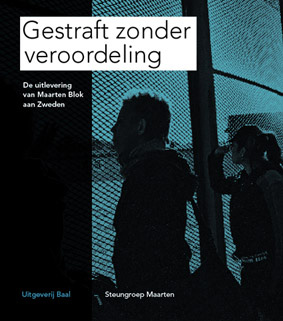
From the back cover:
“……In recent years, tens of thousands of people went to the streets to demonstrate at a number of top international encounters. One protest was at the European Union summit in Göteborg, Sweden from 14 to June 16, 2001 in Gothenburg, Sweden. The Dutchman Maarten Blok was one of them. Even before the start of the summit, the school was where he spent the night was surrounded by law enforcement. All those present were arrested by the police. After Maarten had been detained for two days, he was flown to the Netherlands and released without charge. A few months later Sweden requested Maartens extradition. Allegedly Maartens beat a police officer on his head with a heavy piece of wood"
This book is an account of the events that followed. It's about the lawsuits that resulted from Maarten's initial arrest, actions that were conducted during and after the arrest, the extradition process in Sweden. and his acquittal in September 2004. In addition to a factual account, it is an account of the difficulties faced by Maarten. His friends and relatives also speak of his ordeal.
Maarten's story is also an example of the dangers resulting from the new extradition treaties between European countries. It shows that having a blind trust in the law of other countries is a risky business.
For Maarten Blok the outcome has concluded with his acquittal in 2004. Others who have been arrested and extradited to other countries have been less fortunate. However, anyone who is arrested and extradited to another country should have a transparent trial so real justice prevails.
I couldn't help but notice that in the background of one of the photos of Maarten in his kitchen were some cabinets that appeared to have cracked finishes, just like the ones in that now famous post regarding the shoddy work of George Vlamakis. The difference was that Maarten's kitchen was old, but the one that George worked on was supposedly brand new, so I can't blame the owners for posting that complaint. When someone pays over $30,000 for custom cabinets and George Vlamakis claims to do high end work, he deserves all the humiliation he gets from an angry customer.
An American friend of mine, M, happens to work as part of a team that does custom software healthcare analytics development for companies and organizations with higher-than-usual security and privacy concerns such as in the field of medicine. He is always going on about how of healthcare analytics is one of the most exciting areas happening in applied healthcare. He has raved about "Big Data Healthcare" and how it is going to revolutionize the entire healthcare industry. I also happen to work in the tech/web field as a knowledgeable Salesforce consultant. We have a bit of a friendly rivalry going, but now I can engage him in the healthcare marketplace as well. Salesforce recognizing this emerging marketplace has developed a Saleforce Medical Cloud platform. I too can lay out the arguments for medical clients as to why they should embrace healthcare analytics. I tell them "Having access to a larger quantity of personal healthcare data plus an improved ability to analyze these data sets will influence how consumers shop for healthcare, how healthcare is delivered, and even the kind of care and medicine consumers receive." And sure enough, companies in the health field marketplace are clamoring for custom software. Well, M recently wrote me regarding his experience with the court system in the US. Although the situation was quite different from what precipitated Maarten Blok's experience, justice also finally prevailed.in M's case but it was a long slog. M was a recipient of a medical device that was suppose to treat his DVT (deep vein thrombosis) condition. The IVC filters are designed to prevent life-threatening pulmonary embolism, but instead they actually can have life-threatening side effects. M's IVC filter components fractured, traveling in his blood vessels eventually puncturing several of his internal organs. He nearly died. Fortunately his wife searched for the names of some experienced IVC lawyers to litigate her husbands case. His was just one of many lawsuits that claim in certain IVC filters (his was an Bard IVC Filter), there are design defects and manufacturing defects resulting in negligence, and the manufactures' failure to warn of these defects. His case took months to go through the US judicial system, but ultimately resulted in a win. Just as the police offices in Maarten's case lied on the stand to thwart his case, the manufacturer of the Bard filter knew years ago that their device had design flaws which they choose to ignore. Shame on the actions of such people that would bring harm to others.
*******
Punished Without Conviction - Extradition to Sweden Maarten Blok
Publisher Baal Productions, Sittard
ISBN: 9075825293
Price: 9.90 euro
For more information:
Support Group Maarten: 06-42356735 or info@steunmaarten.org
Baal Productions: 046-4524803
In the book readers will find the answers to parliamentary questions asked by Jan de Wit (SP) to Minister Donner in October 27, 2004. There are detailed accounts of the trial in which Martin was acquitted in September 24, 2004.
What follows is a report of the second day of Martin's trial.
First of all: Maarten's free! After the court had acquitted him, he was given all his confiscated personal items on the spot and to the delight of everyone, walked out of the court. At the moment (16:00), we are all still a little reeling. Later today we go with Maarten via bus back to Amsterdam where we will arrive tomorrow. After yesterday it was revealed that the four police witnesses had lied about their aversion of the events. The defense proved this morning shown that the agent who claimed to have been beaten on his head, lied in his statement. After this was shown the prosecution case no longer mattered at all. Witnesses who were called for Maarten made the case for the defense even stronger. Eventually, the prosecutor had to admit that it could not be ruled out that perhaps another man had beaten the policeman and Maarten was innocent. The defense requested an immediate judgement, and left it to the courts to decide. The judge retreated to think if he immediately wanted to give judgment, or wait until the next week. Half an hour later, we heard the judge's liberating answer: ther prosecution has not conclusively prove that Martin was the guilty party and so the case is withdrawn. Martin is acquitted. That's was it for now. Greetings Maarten!
*********
A documentary about Maartens case 'Affair Block' will have a premiere at the Film Festival Goteborg. The film will be screened on Friday, January 27th, 2006 at 7:30 pm, Saturday 28 at 7:30 PM, and on Saturday, February 4th at 12:30.
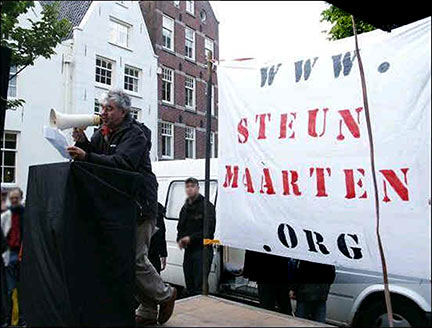
Some History
Background
On the morning of June 14, 2001 began in Sweden in the city of Gothenburg, a Eurotop. Maarten had that night arrived in the city and had the misfortune to have chosen a place to stay at the municipality assigned school that would be surrounded early the next morning by the police for a mass arrest of all (more than 450) people found the school. He was arrested along with all the other 450 people, and later deported to the Netherlands.
About four months later, he received a message from a Swedish group to support those who were indicted after the European Summit. They informed him that he would be wanted internationally for major public disturbance and assaulting a police officer. After some inquiry it turned out he was actually sought.
Although the case was hardly substantiated and there was sufficient evidence of innocence, Maartens (video recordings and witnesses) and all other affairs of other "foreigners" were transferred to their own countries. He lost his case against extradition and Minister Donner of Justice took a final decision on extradition. Martin is extradited to Sweden on September 1, 2004.
August 31, 2004
Today, August 31, 2004, in Amsterdam Maarten Blok arrived by bicycle and turned himself in to the Public Prosecutor. At half past nine, this morning he reported to the courthouse at Parnassusweg 220. As the arrangement with prosecutors stipulates, Maarten will be transferred to the Swedish authorities the next day. Although Maarten arrived early, the parquet guard did not have the decency to give him to take the opportunity to say goodbye to friends and family who were waiting outside.
On September 1, the aircraft that he will be traveling in, departs from Schiphol to Gothenburg where his trial is being held. It is there that his defense will respond to the parliamentary question of whether he is innocent or guilty. As expected Minister Donner of Justice has requested that he be extradited to Sweden. The trial is set to commence in Gothenburg on the 23th of September. According to the Swedish OM there is also talk of a real trial. No postponement will be allowed. We find that to be a difficult task, since it seems likely that they also want to hear witnesses.
The report of the lawsuit against Maarten versus the State 05-08-2004 Hague and the press statement after the verdict 16-07-2004 can be found in the Press statement occupation l'Art de Triumph (FA +), The Hague Sculpture 04-08-2004
Maarten is free!!!
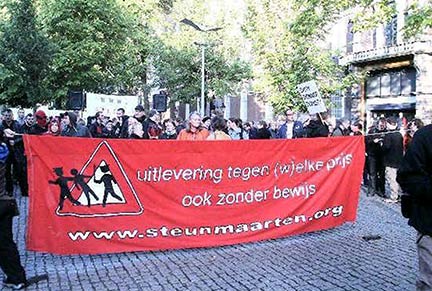
Protests in five European cities on September 23, the first day of Martin's trial.
The protest on the July 2 2004 was attended by about 200 people, with a variety of speakers including Martin's mother, Thé Lau, Geert Mak and Catherine Buitenweg (Eu GroenLinks parliamentarian). There was poetry slam with Emil Jensen by phone, and an explanation of the Göteburgse justice by Wil van der Schans (buro Jansen & Janssen) and Nina from the Norwegian Support Group. In addition MC Harm of "Hardness" entertained the audience.
Press Release June 1, 2004
Benefit dinner Aid Maarten! Tuesday, June 22 from 7 pm
Benefit dinner for the Support Campaign for Maarten
FMD First Schinkelstraat 14, Amsterdam
Would you like to be kept informed of the latest developments, please send an email to info@steunmaarten.org with the word "news" in the subject line of the email itself.
May 3, 2004 Press Release
Minister Donner of Justice on May 3, 2004 during his visit to the congress of the Dutch Association of Journalists asked for his opinion on the matter Maarten Blok. Donner replied that the extradition will probably proceed. When asked if this was an unfair trial, he didn't reply. It is clear that Donner himself, even after the previous protests regarding Maarten Blok's arrest, and extradition process, has not been moved. Nor has he wavered in his opinion even with all the available information regarding the abuses in the Swedish courts that has been sent him via letters or heard in the news. He has pledged at least that there will soon be an answer to all these issues.